Cards and servers
A card’s Claude works on code. When its work needs a server (a deploy, a migration, a look at production), it doesn’t ssh anywhere itself: it hands the work to the organization’s infra Claude, which runs it in panes you watch and approve. Questions and results come back into the card’s conversation.
How a card hands work over
Section titled “How a card hands work over”Cards of an organization with a servers file get two things in their Claude session:
- Instructions to never touch the organization’s servers themselves (no ssh, scp, remote psql,
kubectl against production), and to use
desk peerinstead. - Permission to run
desk peerwithout asking you.
-
The card’s Claude runs
desk peer do Globex --from DESK-5with the task: what to do, where, the steps, how to check it worked and how to roll back. -
desk opens an infra session for that card in the background, with a Claude of its own, and gives it the task.
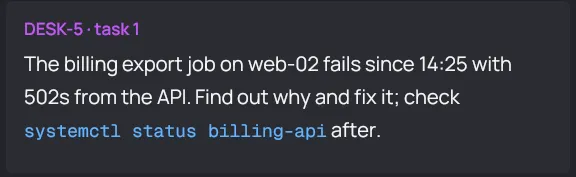
The task, as the infra Claude got it. -
The infra Claude works on it in panes, and every change waits for your approval, as always.
-
Its questions, results and messages come into the card’s conversation. The card’s Claude answers them itself, with
desk peer answer.
On the card
Section titled “On the card”While a card has a task open with the infra Claude, it shows an orange ⇄ org infra pill:
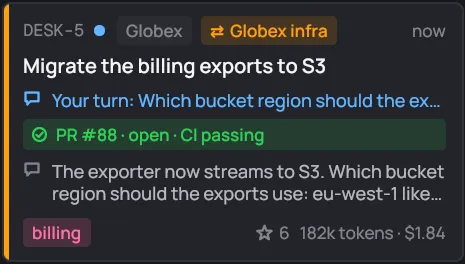
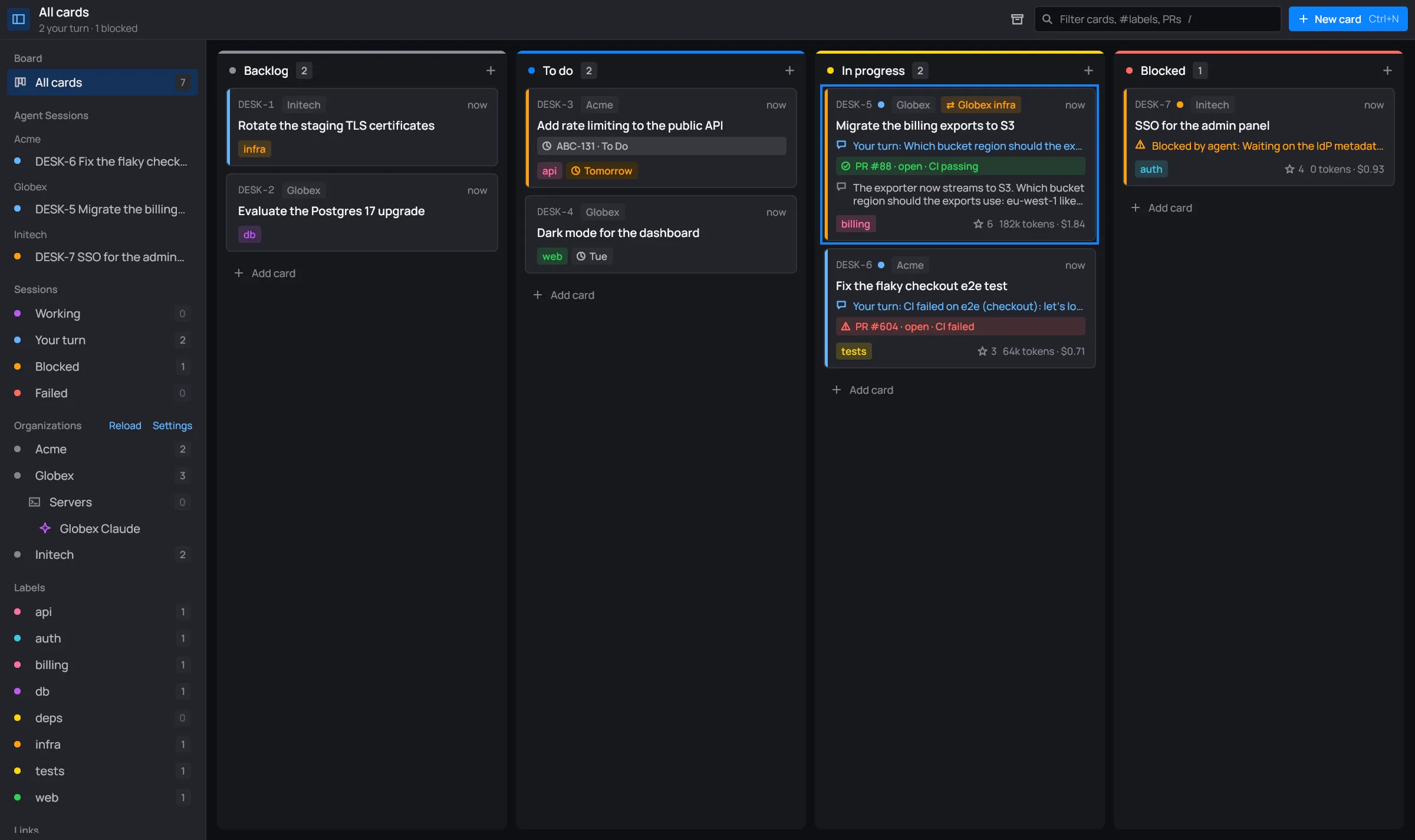
The card’s session header has the same, with the task’s number:

In the card’s conversation
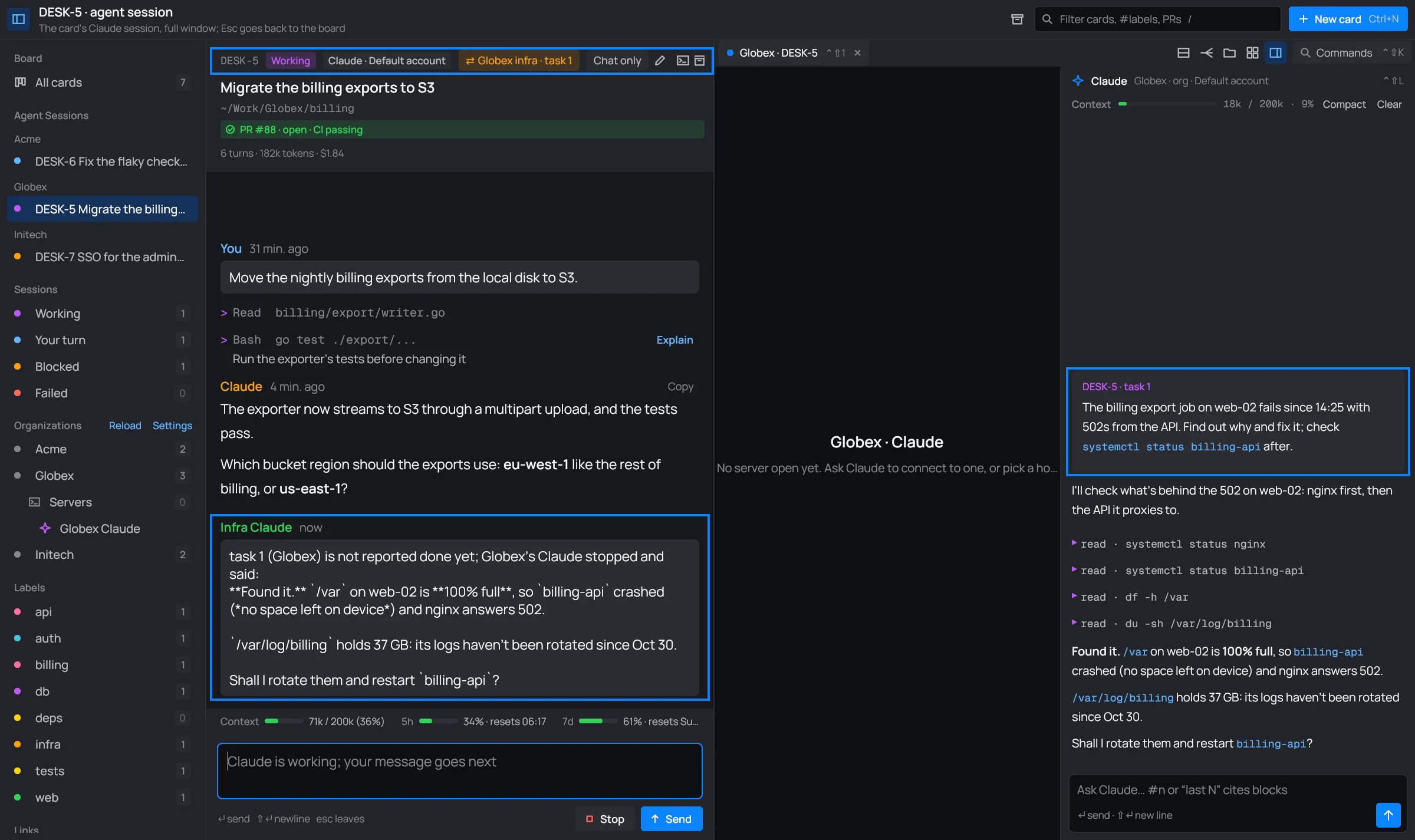
Section titled “In the card’s conversation”What the infra Claude sends shows in the card’s conversation as Infra Claude, in green, and goes to the card’s Claude as a message:
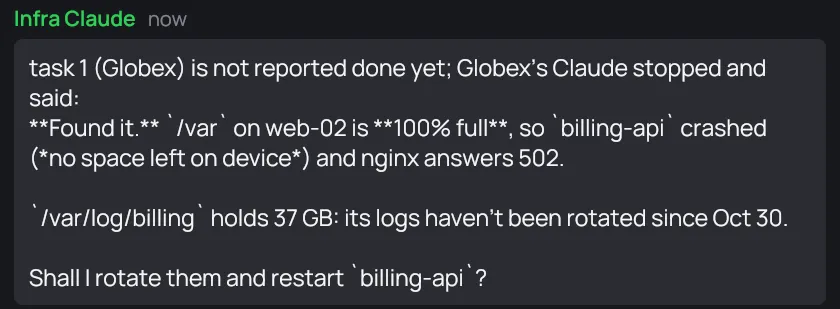
- A question: the card’s Claude answers it with
desk peer answer. You see the answer in the infra session, as a peer entry. - A result: “result of task 1 (Globex)”, with done, failed or rejected by user, and a summary.
- A stop before the end: when the infra Claude ends its turn without reporting the task done (it’s waiting for you, or asking), the card gets what it said.
- A message: the infra Claude can also write to a card on its own (see below).
If the card can’t take a message right now (its terminal is open, a ! command runs, or a
permission question is up), desk holds it and delivers it with your next message or at the end
of the turn.
One infra session per card
Section titled “One infra session per card”Each card that hands work over gets its own infra session, with its own Claude, apart from the organization’s own session and from other cards’. Two tickets’ server work never mixes, and the session’s panes are the servers that one card needs. Its tab is named after both, Globex · DESK-5; the organization’s own tab is just Globex.
In the Servers view, the cards whose work an organization’s sessions hold show as buttons above the tabs, ← DESK-5 Migrate the billing exports to S3. A click goes back to the card. Cards in Done don’t show.
The split view
Section titled “The split view”Open a card’s session in full window and, once the card has handed work to an organization, desk splits it: the card’s chat on the left, its infra session on the right (the first screenshot on this page).
- The header’s Chat only goes back to the chat alone; Split with org servers splits it again.
- The split stays after the task ends, so you can go back and look.
- The side panel on the board doesn’t split.
When the infra Claude writes first
Section titled “When the infra Claude writes first”The infra Claude has two tools for the board:
message_cardwrites to a card’s Claude unasked: a finding, a request for context (“which migrations does this release run?”). It shows in the card as an Infra Claude entry, and the card’s Claude can reply withdesk peer tell.create_cardputs follow-up work on the board: a new card in To do, in the organization, with a title and Markdown notes ending in “(From Globex’s infra Claude.)”. desk says so in a toast, “Globex’s infra Claude made DESK-8: …”. No session starts until you start it.
desk peer
Section titled “desk peer”desk peer is how any Claude Code session (or you) talks to the running desk’s infra Claude:
desk peer # orgs, their sessions, and this helpdesk peer tell ORG [--from NAME] # context: what the service is, its DB, configsdesk peer suggest ORG --cmd CMD --why WHY # propose one commanddesk peer do ORG [--from NAME] # hand over a taskdesk peer wait [--from NAME] [--timeout S] # wait for a question or resultdesk peer answer ID [--from NAME] # answer question IDtell,doandanswertake their text on stdin or with--text.--fromis who’s asking. It defaults to the current folder’s name. A card’s key (--from DESK-5) sends the work to that card’s own infra session; any other name goes to the organization’s session.ORGis an organization from the list, in any case.tellandsuggestare context for the infra Claude, not orders: it gets them with its next question or task.doanswers “task 1 started in Globex”, or “task 2 queued” when that session is busy.waitblocks until something comes, then prints it. Cards don’t need it (desk brings the events into the card); other sessions run it in the background, again after each event.- With no desk running, it says “desk is not running. Ask the user to start desk, then try again.”
desk peer do Globex --from DESK-5 <<'EOF'Deploy billing-api 2.14.0 on web-01 and web-02, one at a time.Check: curl -fsS http://localhost:8080/healthz on each.Roll back: systemctl start billing-api@2.13.3.EOFClaude Code outside desk
Section titled “Claude Code outside desk”Claude Code sessions outside desk can do the same with the plugin in the repository’s
plugin/ folder. Its infra skill tells Claude to hand server work to desk with desk peer:
run desk peer first, give context with tell, hand over tasks with do, run desk peer wait
in the background and answer questions with desk peer answer, and never send secrets.
The repository is a plugin marketplace named desk, with the plugin desk:
claude plugin marketplace add lfdominguez/deskclaude plugin install desk@deskThe plugin needs a running desk and the desk command on your PATH.