The company
desk works like a small tech company. Every card’s Claude can hand work to desk’s roles, Claude
Code agents desk brings, through the Agent tool:
| Role | Name | What it does | Can |
|---|---|---|---|
| Tech lead | desk-tl |
plans work with several parts, briefs the specialists, checks what comes back | everything, and hand work on |
| Architect | desk-architect |
designs how a change fits before it’s built, reviews designs | read |
| Senior developer | desk-senior-dev |
implements a part with its tests | read, edit, run |
| QA | desk-qa |
checks a change against what it had to do, independently | read, run |
| DevOps | desk-devops |
builds, CI, containers, infrastructure code, deploy preparation | read, edit, run |
| Security | desk-security |
looks for vulnerabilities | read, run checks |
| CTO | desk-cto |
decides technical direction that is hard to undo | read |
| CISO | desk-ciso |
approves, with conditions, or refuses changes to secrets, access, the network | read |
| CFO | desk-cfo |
says whether a cost is worth it, with the numbers | read |
The executives are the organization’s own: a card’s Claude only reaches its own organization, so its CTO, CISO and CFO are that organization’s. Only the tech lead hands work on; the others say in their result which skill is needed next.
How they work together
Section titled “How they work together”A role gets a brief: the objective, where to look, the limits, and when it’s done. It answers in a
short result whose last line is a verdict: VERDICT: READY, VERDICT: BLOCKED <why> or
VERDICT: PARTIAL <what is missing>. The card’s Claude reads it before relying on it, and the
subagents show in the session’s rail and on the card’s canvas like any other.
Claude decides when a role helps: a part that needs a specialist, an independent check, work that can run in parallel. Small tasks it does itself. Executives decide or recommend; pushes, deploys, spending and access changes stay yours unless the organization’s own workflow says otherwise.
Department leads
Section titled “Department leads”Beside the roles a card’s Claude runs for one task, every organization has department leads: long-running Claudes that keep the department’s decisions from card to card.
| Department | Lead | Keeps |
|---|---|---|
engineering |
Engineering lead | the architecture, the conventions, the decisions taken and why, the work in flight |
security |
Security lead | secrets, access, exposure, dependencies, what was approved and on what conditions |
finance |
Finance lead | what the work costs, and what was agreed to spend |
| servers | the infra Claude | the organization’s servers; reached with desk peer |
A card’s Claude briefs one with its ask_lead tool: the department, the objective, and if it can,
where to look, the limits, when the answer is complete and the decision it needs. The lead starts
the first time it’s briefed, in the organization’s folder under its account, and only reads (it
never edits or runs anything: Read, Glob, Grep and skills are its only tools, without your MCP
servers). Its answer comes into the card’s conversation as a message from
it, ending in a verdict line, and the card’s Claude goes on with it.
A lead is one Claude Code session per organization and department, resumed every time
(.desk/company/leads.json), so it remembers what it answered before. It is the organization’s
own, like its executives: other organizations’ cards never reach it.
The company log
Section titled “The company log”Every hand-off between an organization’s Claudes goes to <Org>/.desk/company/log.jsonl, one JSON
line each:
- a subagent’s brief and its result (desk’s roles and the organization’s own agents);
- a brief to a department lead and its answer;
- what a card tells or hands the infra Claude, and what comes back (messages, task results).
{"at":"2026-11-16T10:42:07-03:00","kind":"brief","from":"DESK-12","to":"desk-qa","card":"DESK-12","text":"Verify the API split…"}{"at":"2026-11-16T10:51:30-03:00","kind":"result","from":"desk-qa","to":"DESK-12","card":"DESK-12","text":"…\nVERDICT: READY","verdict":"READY"}kind is brief (work handed over), result (its answer) or message; verdict is read off a
result’s last VERDICT: line. It’s a plain file, to read or grep.
The Company view
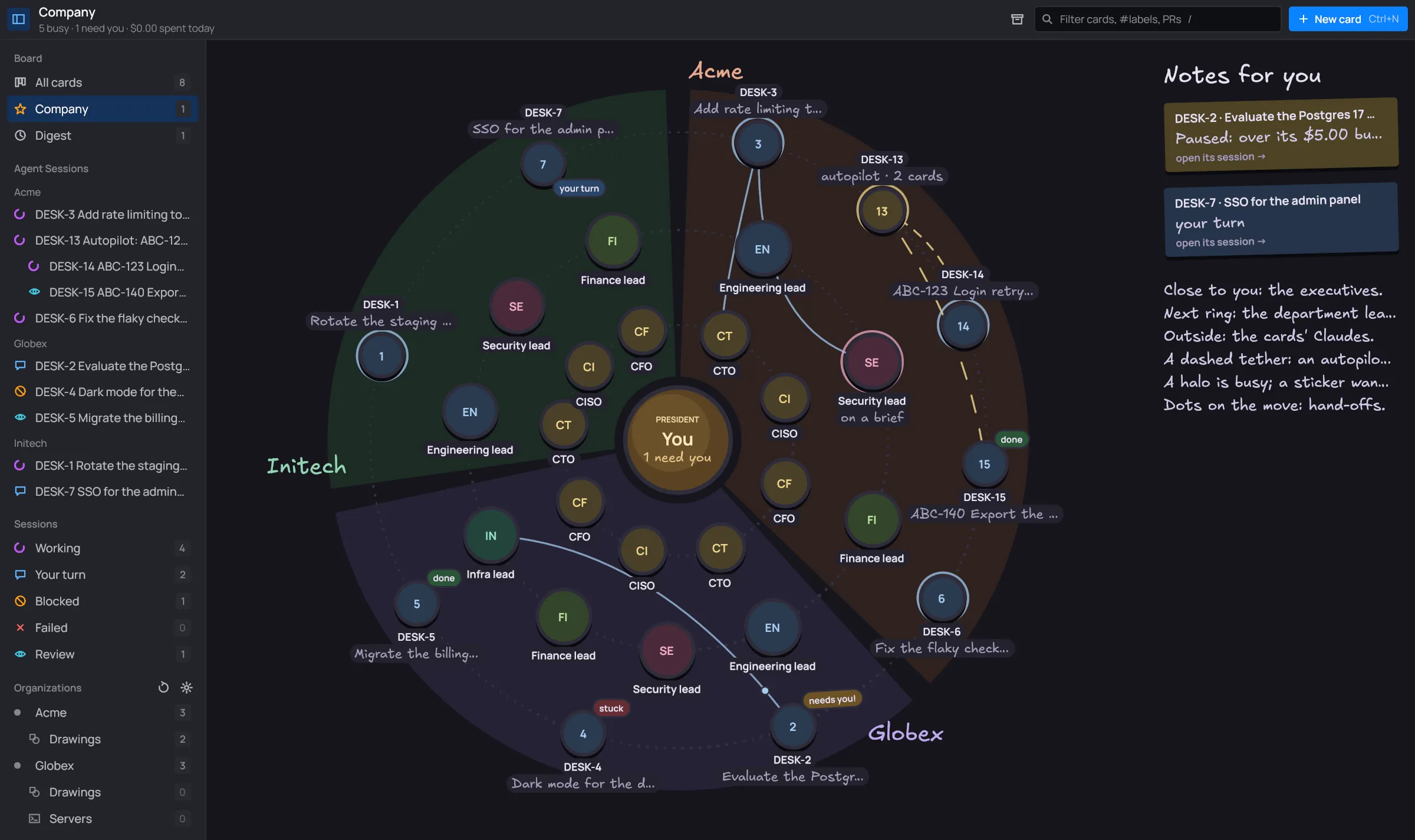
Section titled “The Company view”Company, under All cards in the sidebar, shows the whole company at once, as a small solar system on dark paper, in muted pastels that sit with the rest of the app:
- You are the sun in the middle, with how many cards need you.
- Each organization is a dark pastel slice of the sky with three rings: its executives (CTO, CISO, CFO) closest to you, its department leads (and the Infra lead, when it has servers) next, and its cards’ Claudes outside, each with its key and title.
- A dashed tether ties an autopilot to each of its cards, which sit next to it on the outer ring; its own planet says how many cards it runs.
- A halo around a planet means it’s working: a card’s session, a lead on a brief, an executive consulted by a card right now.
- A sticker says what a card wants: needs you! (a question, a permission, a paused budget), your turn, stuck (blocked or failed) or done (up for review).
- Dots flying between planets are the hand-offs of the last minute and a half, from the company log.
- Notes for you, on the right, lists the cards that need you or wait for your turn. Click a note, or a card’s planet, to open its session.
The sidebar’s count is the cards that need you; the header says how many are busy and what the organizations spent today. It only animates while something is busy, slower when desk isn’t focused.
Who decides what
Section titled “Who decides what”Every card’s Claude is told who takes which kind of decision in its organization, and to ask them before acting on it:
| Decision | Who, unless the organization says otherwise |
|---|---|
| architecture | desk-cto |
| security | desk-ciso |
| spending | desk-cfo |
| merge | desk-tl |
| deploy | you |
| access | you |
A role recommends; what it can’t grant still comes to you. The organization changes or adds rows
in its desk.toml, naming a role, one of its agents, or user:
[company.decides]security = "sec-review" # our own agentmerge = "user"release = "desk-tl"Budgets
Section titled “Budgets”An organization can cap what its sessions spend, in US dollars. Set them in
Settings → the organization → Company (Per card, dollars and
Per day, dollars), or in its desk.toml:
[company]card_budget = 5 # a card's session, between two of your messagesday_budget = 40 # all the organization's sessions, in a daydesk adds each turn’s cost to the organization’s day (.desk/company/spend.json). When a turn
ends over a budget, the card pauses: it waits for you with Paused: over …, and what other
Claudes send it (a lead’s answer, the infra Claude’s result, the workspace Claude’s) waits too.
Your next message continues it, with what waited, and its budget counts again from there. A
turn already running isn’t cut short: the check comes when it ends.
The organization’s own come first
Section titled “The organization’s own come first”An organization’s own CLAUDE.md, skills, agents and workflows always win: desk tells every
Claude to use them when they cover the work, and its roles only fill what they don’t. Claude says
which it used.
An agent of the organization’s with a role’s name (tl or desk-tl) takes that role’s place.
Its desk.toml can also map a role to one of its agents, skip roles, or turn desk’s off:
[company]skip = ["cfo"]          # no desk-cfo for this organization# off = true            # none of desk's roles
[company.roles]tl = "planner"          # our planner is the tech lead: no desk-tldevops = "ops"
Every card’s session gets the roster: the organization’s agents, then desk’s roles it keeps, whether or not the card runs as an agent (its Agent row).