Model providers
Every Claude desk starts is Claude Code, and by default it runs on your Claude subscription (the organization’s account, see Organizations). Claude Code can talk to any endpoint that speaks Anthropic’s Messages API instead: OpenRouter has one, and proxies such as LiteLLM or claude-code-router put one in front of OpenAI-style APIs (OpenAI, Azure, Ollama, vLLM). A model provider is such an endpoint, set up per organization. Each of desk’s Claudes can run on it or stay on the subscription: Explain on OpenRouter while the card’s own work stays on Claude, for example.
Adding a provider
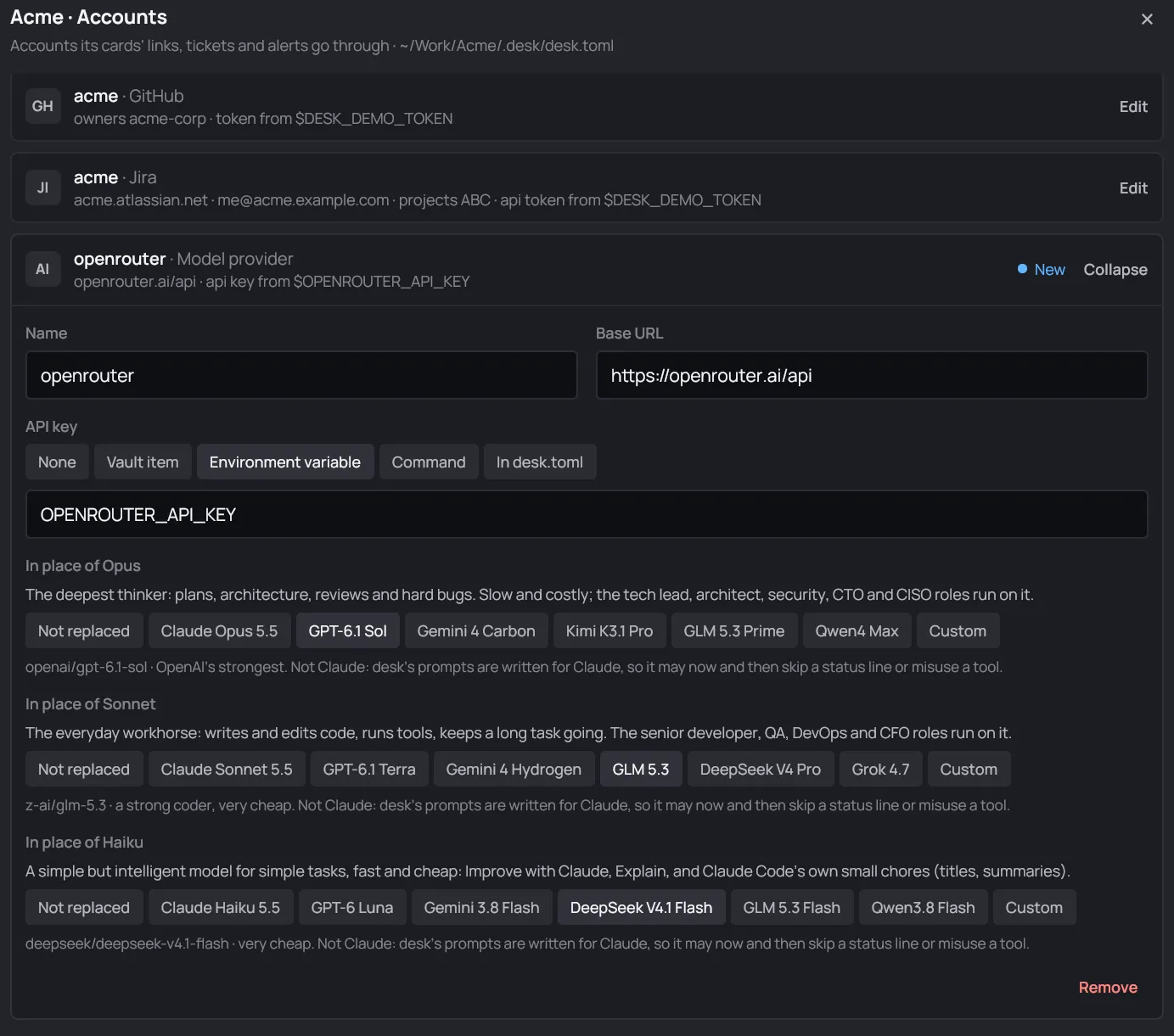
Section titled “Adding a provider”In Settings, an organization’s Accounts page has + Model provider among the account buttons. Its card has:
- Name: what the Models page calls it, for example
openrouter. - Base URL: the endpoint,
https://openrouter.ai/apifor OpenRouter. It must speak Anthropic’s API, not OpenAI’s (OpenRouter’s/api/v1is its OpenAI one). - API key: where its key comes from, like any account’s token: a vault item, an environment variable, a command, or the file itself (see Tokens). Claude Code sends it in place of your login.
- In place of Opus, In place of Sonnet, In place of Haiku: the model the provider answers when Claude Code asks for each of Claude’s. Each says what that Claude is for:
| Claude | What it does in desk |
|---|---|
| Opus | The deepest thinker: plans, architecture, reviews and hard bugs. Slow and costly; the tech lead, architect, security, CTO and CISO roles run on it. |
| Sonnet | The everyday workhorse: writes and edits code, runs tools, keeps a long task going. The senior developer, QA, DevOps and CFO roles run on it. |
| Haiku | A simple but intelligent model for simple tasks, fast and cheap: Improve with Claude, Explain, and Claude Code’s own small chores (titles, summaries). |
For each, pick one of the models that come close to it (OpenRouter’s names: Claude itself, paid per token, then OpenAI’s, Google’s, Moonshot’s, Z.ai’s, DeepSeek’s, Alibaba’s, xAI’s…), Not replaced (Claude Code asks for Claude’s own model by its name, which only works where the endpoint has Claude), or Custom, a field for any model id. A model that isn’t Claude says what it may get wrong; Custom says it louder, since desk knows nothing of it. Another endpoint may name the suggested models differently: the card says so when the base URL isn’t OpenRouter’s.
Save refuses a provider without a name or a base URL, and two with the same name.
Which Claude runs where
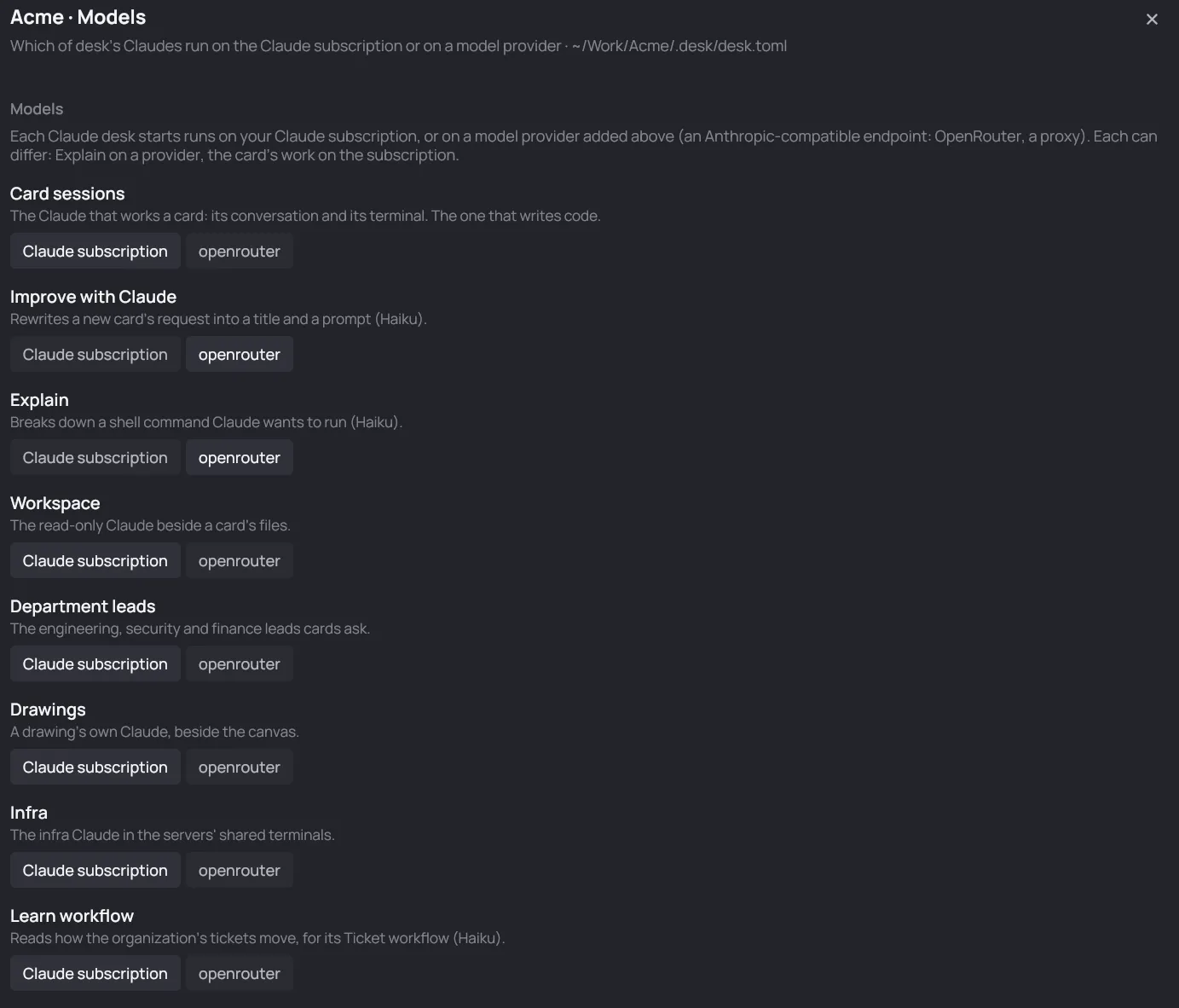
Section titled “Which Claude runs where”The organization’s Models page in Settings has a row per Claude desk starts, each with Claude subscription and the organization’s providers to pick from:
| Row | The Claude |
|---|---|
| Card sessions | The one that works a card: its conversation and its terminal. |
| Improve with Claude | Improve with Claude in the new-card dialog. |
| Explain | The breakdown of a shell command in a session. |
| Workspace | The workspace’s read-only Claude. |
| Department leads | The leads cards ask (see The company). |
| Drawings | A drawing’s Claude. |
| Infra | The infra Claude in the servers’ terminals. |
| Learn workflow | Learn, in an organization’s ticket workflow. |
A change counts from the next time that Claude starts. A running card session keeps its provider until it ends; the session’s foot shows Model via <provider> in place of the plan’s limits, which aren’t the provider’s.
Save refuses a row on a provider the organization no longer has.
The roles’ models
Section titled “The roles’ models”Company roles, on the organization’s Company page in Settings (beside its budgets), sets the model each of desk’s roles runs on as a card session’s subagent: Its own (the one its file says, shown beside it), Opus, Sonnet, Haiku, or The session’s (whatever the card’s session runs on). On a provider, Opus, Sonnet and Haiku are what it puts in their place, so the tech lead can think on one model while QA runs on a cheaper one.
What changes on a provider
Section titled “What changes on a provider”- Plan limits aren’t shown: they are your subscription’s.
- Cost is what Claude Code reports, priced at Claude’s rates: on another model it’s an estimate, and so are the budgets that count it.
- Claude’s server-side tools (web search and fetch) and the claude.ai Artifact tools (a drawing’s Share) need Anthropic’s servers and your login: on a provider they fail or are missing.
- A provider’s key in a locked vault asks to unlock it, as a link’s does; a key that doesn’t resolve stops the start with why.
In desk.toml
Section titled “In desk.toml”The settings write [[provider]], [models] and [company.models]:
[[provider]]name = "openrouter"base_url = "https://openrouter.ai/api"token_env = "OPENROUTER_API_KEY"opus = "openai/gpt-6.1-sol"sonnet = "z-ai/glm-5.3"haiku = "deepseek/deepseek-v4.1-flash"
[models]explain = "openrouter"improve = "openrouter"
[company.models]qa = "haiku"
See desk.toml for every key.