
Ticket workflow
By default desk moves a card’s ticket by the column’s status category (see Tickets follow their card), and moves back any ticket that drifted. That works until an organization’s statuses mean something of their own: its Test may mean deployed to the testing environment, not someone is testing it, and only QA moves a ticket to Done. The ticket workflow tells desk how that organization works.
Learning it
Section titled “Learning it”In Settings, open the organization in the nav and pick Ticket workflow.
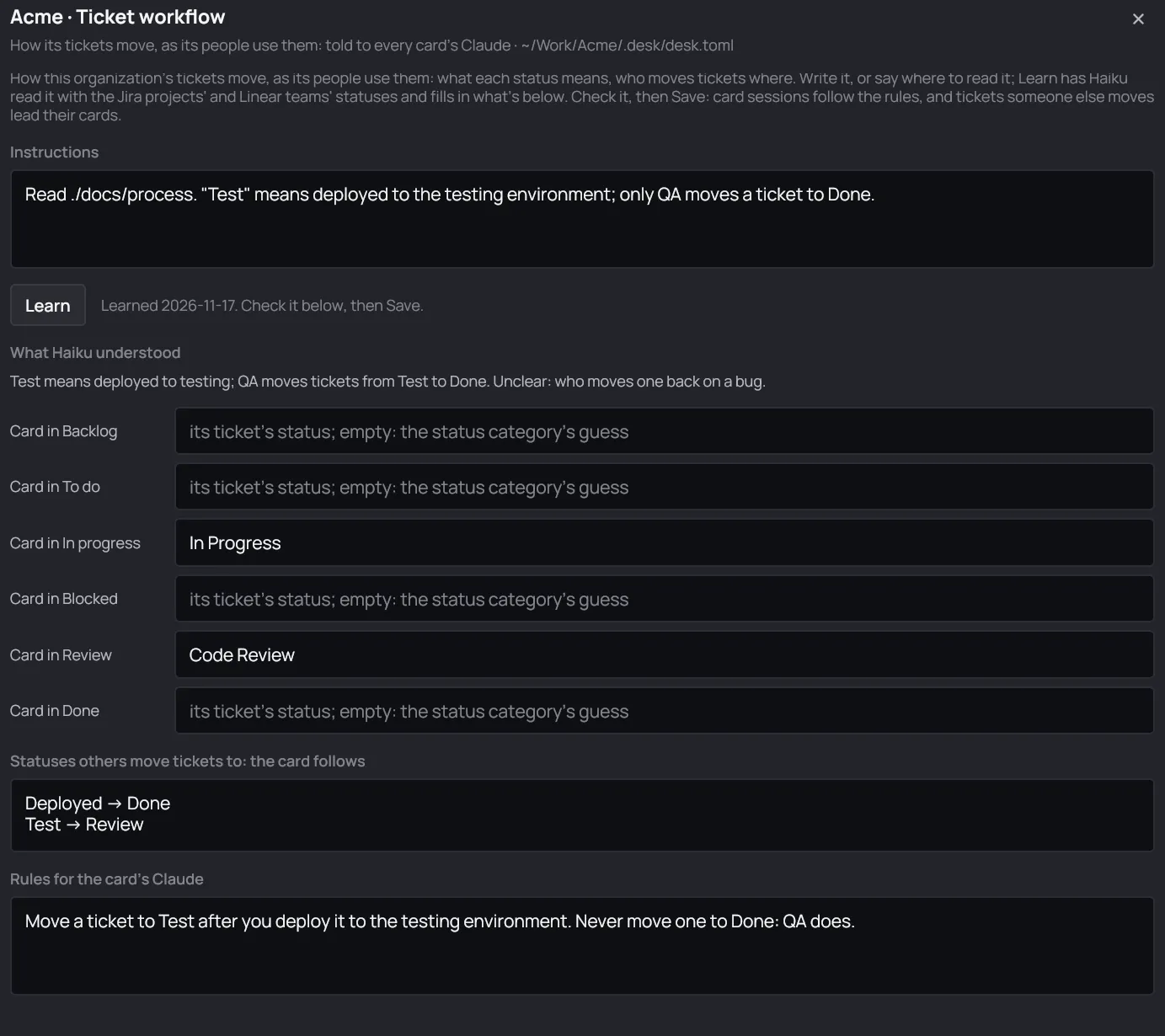
- In Instructions, write how its tickets move, or where to read it: Read ./docs/process. “Test” means deployed to the testing environment; only QA moves a ticket to Done. Paths start at the organization’s folder.
- Learn has Haiku read it, and every file it points at (read-only), next to the statuses of the organization’s Jira projects and the states (with their types) of its Linear teams, which desk fetches. It runs on the provider set for Learn workflow in Models. Stop ends it.
- What it understood fills the fields below, for you to check and change:
- What Haiku understood: its summary, and what was unclear or missing.
- Card in <column>: the status its ticket goes to when a card moves there. Empty: the
status category’s guess, as without a workflow. An account’s own
[jira.status]or[linear.status]still wins. - Statuses others move tickets to: one
Status → Columnper line. When someone puts a ticket in one of them, the card follows to that column. - Rules for the card’s Claude: what each status means here, when Claude moves a ticket itself, and what it must never do.
- Save. Nothing applies before.
Save refuses a line of the statuses others move to that doesn’t name a column of the board.
What changes
Section titled “What changes”- Every card’s Claude of the organization is told the rules, and gets a
ticket_statustool to move a ticket of its card by the status’s name (a Linear issue: a state of its team) when the rules say so (after it deploys to testing, say). A status it can’t reach comes back with the ones it can. Only your own tickets move, never through an account withsync = false, nor out of a status itsignoreleaves to others. - The card follows its ticket. When someone moves a ticket to a status the workflow gives a column (the statuses others move to, or a column’s status read backwards), its card moves there, with a toast: ABC-131 is Test: DESK-12 follows to Review. The same when the card’s Claude moves it. When several columns share that status, a card already in one of them stays; otherwise it goes to the first of them on the board. A GitHub issue closed takes its card to Done, and reopened, out of Done to In progress.
- No ticket is moved back. The check at start and every 3 minutes leaves a ticket someone moved where it is: either its card follows it, or both stay.
- Moving a card yourself still moves its ticket, to the column’s status. When it can’t (the ticket is someone else’s, or the move isn’t allowed there), the card stays where you put it: a card follows only a status that changed since the last check, and the first check of a ticket only notes where it is.
In desk.toml
Section titled “In desk.toml”[workflow]instructions = "Read ./docs/process"summary = "Test means deployed to the testing environment; QA closes tickets."rules = "Move a ticket to Test after you deploy it to the testing environment. Never move one to Done."learned = "2026-11-17"
[workflow.status] # a column → its ticket's status"In progress" = "In Progress"Review = "Code Review"
[workflow.follow] # a status others move to → the card's columnTest = "Review"Deployed = "Done"The statuses are names: a Jira status, or a Linear state of the issue’s team. They apply to an organization’s Jira and Linear tickets alike.
See desk.toml.